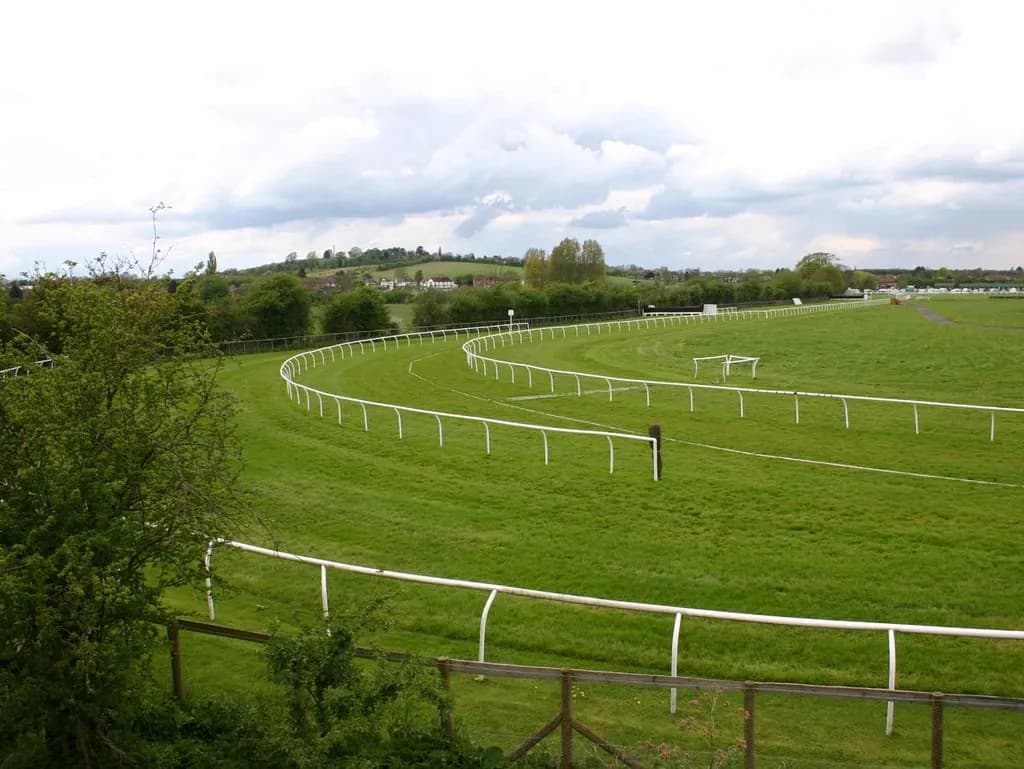
In 1694 the Great Fire of Warwick tore through the centre of the county town. Among the schemes to bring money back was racing, in the hope that horse races would draw wealthy visitors who would spend in the rebuilt streets. The first race on what is now Warwick Racecourse followed in 1707, and the county has been racing, on and off, ever since. For anyone in Rugby, that makes the sport one of the oldest working traditions in Warwickshire, a decade older even than Stratford's first recorded meeting.
This October, though, the county's racing all happens in one place. Warwick does not race until 3 November, so the action moves south-west to Stratford-on-Avon, where three autumn jump meetings close the course's 2026 season.
The October 2026 fixtures at Stratford
- Monday 5 October: a day meeting to start the month.
- Saturday 17 October: the weekend fixture, and the best bet for anyone who works Monday to Friday.
- Thursday 29 October: the last meeting before Stratford's winter break, with the next racing not due until March 2027.
On 5 and 29 October the course has said only Main Enclosure tickets will be on sale, with the Centre Course closed.
How Warwickshire became a racing county
Warwick: the elder statesman
Warwick Racecourse sits on the edge of the town with Warwick Castle as its backdrop. After the first race in 1707 came the first stand in 1809, and the course developed over the following two centuries. The Jockey Club, which owns it today, makes a striking claim for it: that Warwick was the first course to put a jump race on its programme, and so helped shape jump racing as it is known now. Its big modern race, the Classic Chase, was established in 1974 and is run every January.
For most of its life Warwick staged both codes. That ended in 2014. After a fatal incident that May, the course announced it would give up flat racing, and the final flat fixture was held on 26 August 2014. Warwick is now a jumps course from autumn to spring.
Stratford: racing in hunting country
Stratford's story is bound up with the hunting field. Steeplechasing returned to the town in 1836, and the racecourse's own history records that Lottery, who went on to win the first Grand National in 1839, won a four-mile race at Stratford. Later came the Shakespeare Cup in 1867, a Diamond Jubilee Cup in 1897 and the Warwickshire Hunt Coronation Cup in 1902. By 1904 the meeting was known as the Stratford and Warwickshire Hunt Races.
That heritage survives in Stratford's signature race, the hunter chase for amateur riders on horses that have hunted. Established in 1959, it is now the Champion Hunters' Chase, run as an evening fixture in late spring. Its roll of honour has its heroes: Credit Call won it four times, in 1971, 1972, 1973 and 1975, and Baulking Green won three times in the 1960s.
For the seasoned racegoer
Stratford is about as different from a galloping track as jump racing gets. It is a left-handed circuit of around a mile and a quarter, roughly triangular, with eight fences a lap, two tight bends and three fences in the home straight before a short run-in of about 200 yards. The pace is usually strong, and a horse that is slow from the last can lose a race in a few strides. Course form genuinely counts here, and so does a handy racing position.
October at Stratford is the tail of the summer jumps season. Expect handicap hurdles and chases with plenty of runners who have been busy on decent ground since the spring, along with the odd better horse having an early-season outing. Ground is the variable to watch. Early in the month the course was watering, and quick ground favours speedy, nimble types, while a wet second half of October can bring stayers back into the reckoning. The going report the day before is worth reading closely.
For a first visit
For a first raceday, Stratford's intimacy is a gift. The circuit is compact enough to follow the whole race from the stands, and the walk between parade ring, betting ring and finishing post takes moments.
Use the parade ring to choose a horse you like the look of. A good walker that looks relaxed and well turned out is a reasonable starting point; a horse already lathered in sweat is often one to be wary of.
There are two main ways to bet. Bookmakers on the rails give you a fixed price when you place the bet. The Tote pools everyone's money, takes a share, and divides the rest among the winners. An each-way bet means half your stake goes on the horse winning and half on it being placed. Agree your spending limit with yourself before you arrive, and do not chase losses.
Jumps racegoers tend to dress for the weather, not the occasion. Smart-casual is safe, and a waterproof and comfortable shoes will serve you better than anything formal on an October afternoon.
Making a day of it
From Rugby, the simplest route is by road towards Warwick and then the A46 to Stratford, where the racecourse is signposted on the approach to the town. By train, expect at least one change on the way, with Stratford-upon-Avon station about two miles from the course on Luddington Road.
A Warwick stop on the way is worth considering, if only to see the county's oldest racecourse on a non-racing day. The course lies just west of the town centre, a short walk from the castle, the medieval Lord Leycester Hospital at the West Gate and the tower of St Mary's Church.
In Stratford itself, try the riverside rather than the main Shakespeare streets. Holy Trinity Church, Shakespeare's burial place, stands among trees by the Avon on the southern edge of the town, and from there it is an easy stroll along the river towards the racecourse side of town. The Stratford Greenway, a traffic-free path on the line of the old Honeybourne railway, is ideal for a pre-racing walk or a family bike ride, and the site of the old Racecourse Platform, which served race crowds from 1933 until 1968, lies on its route. In the evening, the lights of the Royal Shakespeare Theatre across the water make a fine end to the day.
Before you go
The Stratford Racecourse website has first-race times, ticket and enclosure details and the latest going. Autumn weather can still cause inspections or abandonments, so check again on the morning of the meeting before setting out from Rugby.