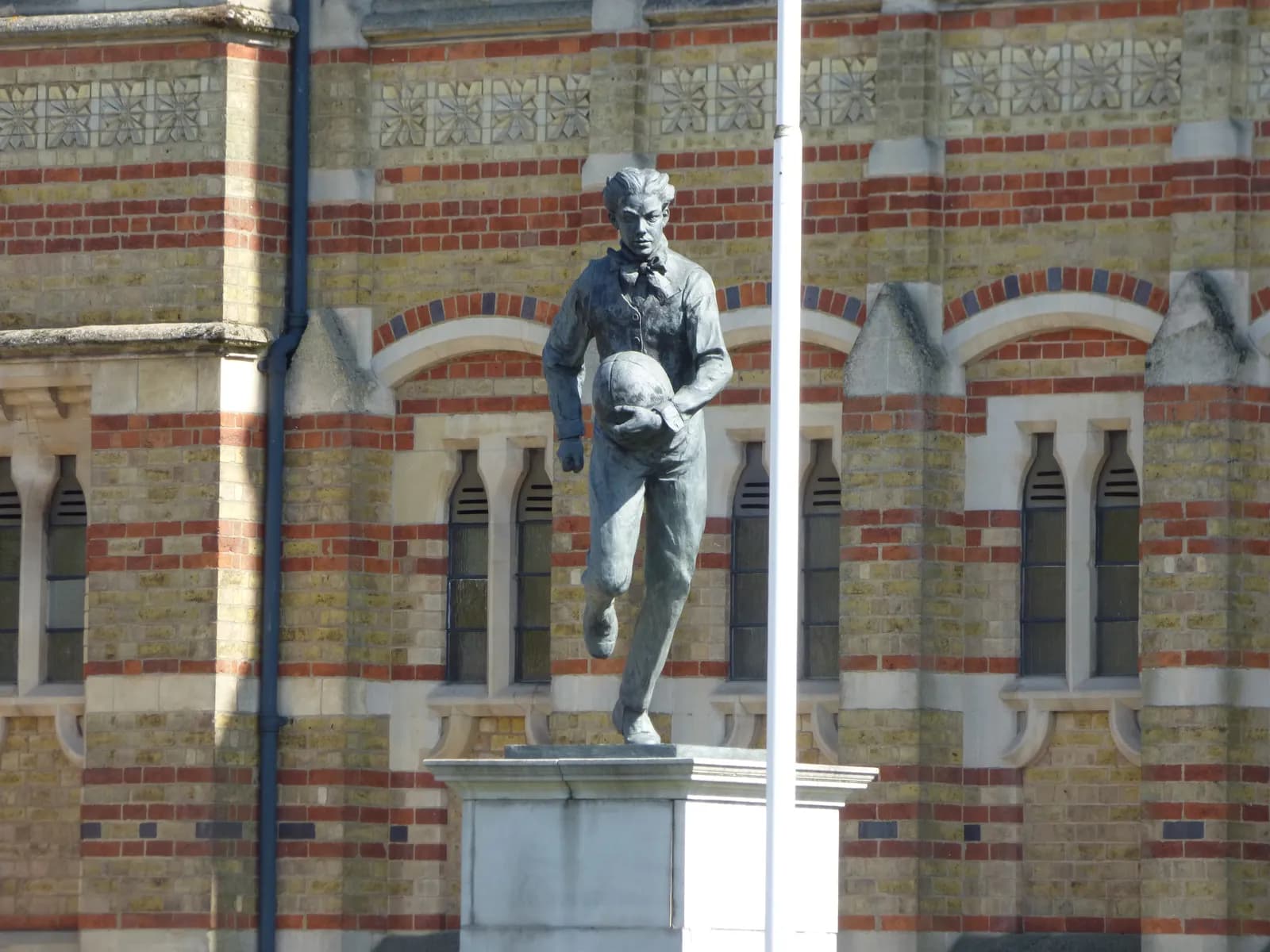
Every Rugby World Cup, millions of television viewers glimpse the trophy named in his honour. The gilt cup bears the name William Webb Ellis, commemorating the schoolboy who allegedly invented rugby football by picking up a ball and running with it on the Close at Rugby School in 1823. The story has endured for more than a century, inscribed on a stone plaque at the school, celebrated by a bronze statue in the town centre, and repeated in sports bars from Buenos Aires to Auckland.
Yet historians have long questioned whether this foundational moment ever occurred. The evidence suggests a more complex story of gradual evolution rather than a single flash of inspiration.
The Plaque and the Problem
On the grounds of Rugby School stands a stone tablet erected in 1895. Its inscription reads: "This stone commemorates the exploit of William Webb Ellis who with a fine disregard for the rules of football as played in his time first took the ball in his arms and ran with it thus originating the distinctive feature of the rugby game A.D. 1823."
The language is decisive. The date is specific. The only difficulty is that the story did not surface until four years after Webb Ellis's death.
Webb Ellis attended Rugby School from 1816 to 1825 as a "foundationer", meaning he received free education as a local boy. He later studied at Brasenose College, Oxford, became an Anglican clergyman, and died in France in 1872. School records note he was "rather inclined to take unfair advantage at cricket", a character trait that would later be recalled regarding football. However, he never claimed to have invented the sport during his lifetime. No contemporary account written in the 1820s mentions such an incident.
Matthew Bloxam and the Origin of the Legend
The sole source of the Webb Ellis story is Matthew Bloxam, a former Rugby School pupil and local antiquarian who wrote two letters to The Meteor, the school magazine, in 1876 and 1880. In his first letter, Bloxam claimed he had learned from an unnamed source that handling the ball originated with "a town boy or foundationer of the name of Ellis, William Webb Ellis".
Four years later, Bloxam elaborated. He now provided the famous "fine disregard for the rules" narrative. But there was a problem. In his first letter, Bloxam stated the event happened in 1824. In his second letter, he changed the date to 1823.
This inconsistency matters. Webb Ellis left Rugby School in 1825. If the incident occurred in 1824, it would have been during his final year. Bloxam's revision to 1823 placed the event earlier in Webb Ellis's school career. Historians note that a sole source with contradictory dates would not meet modern standards of evidence.
The 1895 Investigation and Its Findings
The year 1895 proved pivotal for rugby. In August of that year, 22 clubs split from the Rugby Football Union to form the Northern Union, which would eventually become rugby league. The schism concerned professionalism; working-class clubs in northern England wanted to compensate players for time away from work, while southern amateur clubs opposed payment.
Against this backdrop, the Old Rugbeian Society launched an investigation into the origins of the game. Their sub-committee was "unable to procure any first-hand evidence of the occurrence". Thomas Harris, who left Rugby in 1828, testified that Webb Ellis had been known for taking "unfair advantage at football". But he did not confirm the ball-carrying story. His brother John Harris, who left Rugby in 1832 and was aged ten in 1823, did not claim to have witnessed the incident and stated he had "not heard the story" of Webb Ellis creating the game.
Thomas Hughes, author of Tom Brown's Schooldays and a pupil at Rugby from 1834 to 1842, told the investigation that when he arrived at the school, "running with the ball to get a try... was not absolutely forbidden, but a jury of Rugby boys... would almost certainly have found a verdict of 'justifiable homicide' if a boy had been killed in running in". This suggests that while running with the ball was possible, it was neither common nor officially sanctioned in the 1830s.
The Alternative Candidate: Jem Mackie
Hughes provided the investigation with another name. In 1838 or 1839, he said, "Jem Mackie was the first great runner-in". Mackie, a pupil at Rugby School, is identified by some historians as a more plausible figure in the development of running with the ball. He was later expelled from the school in or before 1842 for an unspecified incident.
Some theorists suggest Mackie's expulsion damaged his reputation sufficiently that Bloxam transferred his role to Webb Ellis, who had become a respectable clergyman. Others point to Bloxam's substantial donation to Rugby School's library as a possible factor in the school's acceptance of his version of events.
What Actually Happened on the Close
The Close at Rugby School, the expanse of grass where pupils played football, certainly witnessed the emergence of a distinctive style of play. But the evidence suggests this emerged gradually through the 1820s and 1830s rather than in a single moment of rebellion.
In 1845, a committee of Rugby schoolboys including William Delafield Arnold, W. W. Shirley, and Frederick Hutchins produced the "Laws of Football as Played At Rugby School". This was the first published set of laws for any code of football. Before this, rules at the school were unwritten customs that varied with each intake of pupils.
The 1845 laws formalised handling and running with the ball. But they did not credit Webb Ellis. The connection between the 1823 story and the codified rules would not be made until Bloxam's letters decades later.
Rugby, Warwickshire and the Heritage Industry
Despite scholarly doubts, the Webb Ellis legend remains central to Rugby's identity. The bronze statue by sculptor Graham Ibbeson stands on Dunchurch Road, unveiled in 1997 by former England international Jeremy Guscott. The Webb Ellis Rugby Football Museum, located in a building dating from 1842 that once housed the Gilbert company (makers of rugby balls), opened in April 1987. It contains memorabilia including a Gilbert ball exhibited at the Great Exhibition of 1851.
The Rugby World Cup trophy, named the Webb Ellis Cup since the inaugural tournament in 1987, ensures the story reaches a global audience every four years. The tournament's opening ceremony often features reenactments of the famous moment.
The Verdict of History
Modern historians generally view the Webb Ellis story as an origin myth rather than historical fact. Eric Dunning and Kenneth Sheard, in their study Barbarians, Gentlemen and Players, suggest the endorsement of a reductionist origin myth was an attempt to assert Rugby School's position during the 1895 schism. England Rugby's official position acknowledges that "William Webb Ellis's action (if it happened) did not lead to any immediate change in the rules" and "at best can only be seen as inspiration for subsequent 'runners'".
What is certain is that Rugby School gave its name to a sport now played by millions worldwide. Whether a single schoolboy picked up a ball in 1823, or whether the game evolved through decades of playground experimentation on the Close, the town of Rugby in Warwickshire remains indelibly linked to one of the world's most popular sports. The legend persists, even as the evidence suggests a more complex truth. Perhaps that is fitting for a game that celebrates both tradition and innovation.