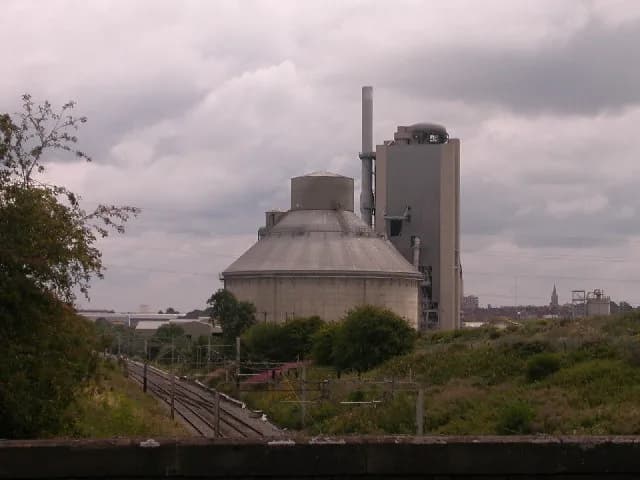
For nearly two centuries, the production of cement has been intertwined with Rugby's identity, transforming a modest market town into an industrial centre and leaving a legacy that persists in the town's landscape, housing, and economy today.
Origins in the Nineteenth Century
The story begins in 1825 when Thomas Walker and his son George established a family business producing lime at New Bilton and Newbold-on-Avon. This small operation laid the foundations for what would become one of Britain's most significant cement manufacturers.
In 1862, the Rugby Lias Lime and Cement Company Ltd was founded as the town's first public cement company. Eight years later, in 1870, the company began producing true Portland cement at its New Bilton site, marking the start of what would become over 150 years of continuous cement production at Rugby, making it Britain's oldest Portland cement plant.
The company was renamed the Rugby Portland Cement Company Ltd in 1872, a name that would remain synonymous with the town for more than a century.
Expansion and Growth
For its first seven decades, the company grew steadily, serving regional markets from its Warwickshire base. The turning point came in 1933 when Sir Halford Reddish became managing director and initiated an ambitious expansion programme.
Between 1934 and 1945, the Rugby Portland Cement Company acquired four additional plants: Southam in 1934, Rochester in 1937, Gillingham in 1939, and Stockton in 1945. This transformed the firm from a regional operator into a national cement manufacturer.
The company's ambitions extended beyond Britain. In 1955, it founded Cockburn Cement Ltd, a subsidiary in Perth, Australia. The 1960s brought further acquisitions, including Eastwood's cement operations in 1962 and the Chinnor plant in 1963.
A remarkable engineering achievement occurred in 1965 when the company opened a 92-kilometre pipeline from Kensworth Chalk Pit in Bedfordshire to the Rugby plant, ensuring a steady supply of raw materials for decades to come.
Building a Community
The cement industry's impact on Rugby extended far beyond factory walls. As production expanded, the company needed workers, and those workers needed homes.
New Bilton, the area surrounding the cement works, emerged as a distinct settlement during the Victorian era specifically to house cement industry employees. Victorian terraced housing spread north of Lawford Road, and by 1905 the area was entirely built up. The community that formed there developed its own character, shaped by the rhythms of cement production and the shared experience of industrial employment.
Alongside the railway and engineering industries, cement became one of Rugby's three major employers, fundamentally altering the town's economic character. What had been a market town serving agricultural Warwickshire was becoming an industrial centre.
Corporate Changes
In 1979, or possibly 1987 according to some sources, the Rugby Portland Cement Company was renamed Rugby Group plc, reflecting its transformation into a diversified building materials conglomerate.
The 1984 acquisition of the Addison Corporation of Atlanta, Georgia, marked Rugby's entry into the American market. The company was now operating on three continents, a remarkable journey for a business that had begun as a small family lime works.
However, the consolidation of British industry in the late twentieth century eventually engulfed Rugby Group. In 2000, the company was taken over by the RMC Group. Five years later, in 2005, RMC itself was acquired by Cemex, the Mexican multinational cement giant. Rugby Cement had become part of a global empire.
Modern Operations and Rationalisation
The late 1990s saw substantial investment in the Rugby plant, with a £200 million upgrade that increased production capacity to 1.8 million tonnes annually. During this period, production was concentrated at Rugby, leading to the closure of the Southam and Rochester plants.
By 2009, the Rugby works accounted for 80 per cent of Cemex's UK clinker output. When the South Ferriby plant closed in 2020, Rugby became Cemex's sole remaining UK clinker production site. Against the odds, the plant that had begun production in 1870 had outlasted all other British cement works in the company's portfolio.
Today, the works tower reaches 400 feet (120 metres) and continues to dominate the New Bilton skyline, visible from across Rugby.
Environmental Challenges
The cement industry's environmental legacy in Rugby has been complex. The plant's waste tyre burning operations, conducted under EU Waste Incineration Directive regulations, have attracted scrutiny. More seriously, in October 2006, Cemex was fined £400,000, later reduced to £50,000 on appeal, after hazardous dust was found to have deposited up to three miles from the Rugby works. The fine was the highest ever imposed under Integrated Pollution Prevention and Control regulations.
The company responded in April 2007 by installing a £6.5 million dust abatement system, which cut particulate emissions by 80 per cent. The episode illustrated the tension between Rugby's industrial heritage and modern environmental standards.
Physical Legacy
The cement industry's physical mark on Rugby extends beyond the working plant. A large disused quarry at Parkfield Road in New Bilton remained as a reminder of decades of limestone extraction. In 2020, plans emerged to fill this quarry with spoil from the HS2 railway construction, potentially transforming a scar of industrial extraction into level ground.
The industry's presence in the town's cultural memory is also preserved. A frieze by artist John McKenna, installed on public toilets in North Street in 1999, depicts Rugby's industrial heritage including cement works cooling towers alongside railway history, the Oxford Canal, and Frank Whittle's jet engine development at British Thomson Houston.
A Town Transformed
From the 1825 lime works founded by the Walker family to the present-day Cemex operation, cement production has shaped Rugby for nearly two centuries. The industry provided employment for generations of Rugby residents, built the community of New Bilton, transformed the town's economy, and left physical landmarks that remain visible today.
The Rugby cement story is one of industrial success, corporate evolution, environmental challenge, and community formation. While the company that began as a family business in 1825 is now part of a Mexican multinational, the works at New Bilton continues production, cementing Rugby's place in British industrial history.