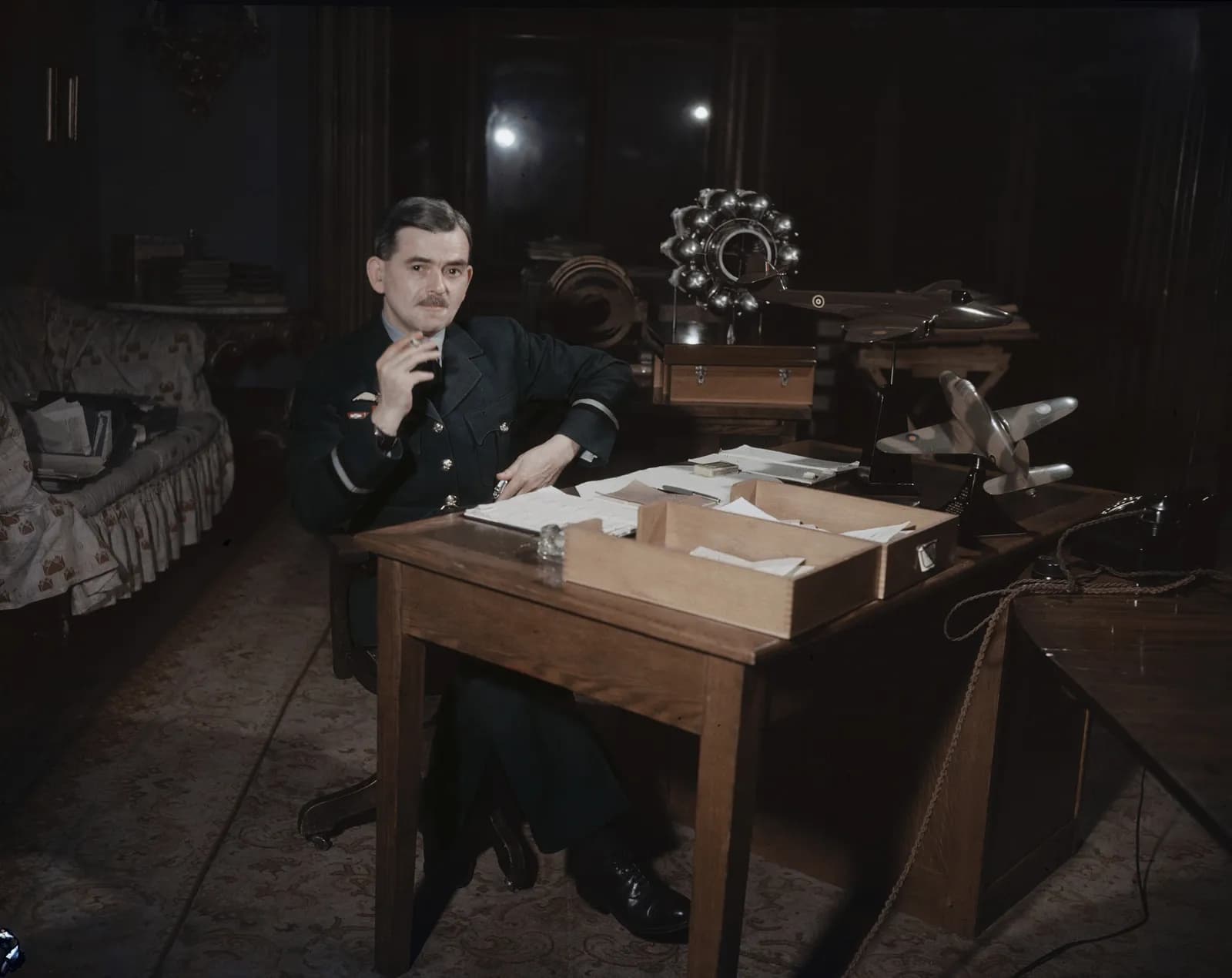
On a spring morning in 1937, a strange sound began echoing across the engineering works of a quiet Warwickshire market town. It was not the familiar clatter of steam turbines, which had been Rugby's industrial signature since 1902. It was something new: a high-pitched whine that marked the first run of the world's first prototype jet engine. A decade later, in 1947, the same factory complex would produce another revolution when a Hungarian refugee perfected a technique that would eventually win him the Nobel Prize. Rugby, population then around 50,000, had become the unlikely birthplace of both the jet age and holography.
The Power Jets Tests at British Thomson-Houston
The British Thomson-Houston works on Mill Road had been Rugby's industrial heart since the factory opened in 1902. By the 1930s, BTH was one of Britain's major electrical engineering firms, and its purpose-built research laboratory, Building 52, had established a reputation for technical innovation. This reputation attracted Frank Whittle.
Whittle, a Royal Air Force officer who had patented the basic concept for a turbojet engine in 1930, had been met with indifference from the Air Ministry. Unable to secure government support, he had watched his patent lapse in 1935. Undeterred, Whittle formed Power Jets Ltd in March 1936 and reached an agreement with BTH to build an experimental engine test facility at the company's Rugby works.
The first prototype, designated the Power Jets WU (Whittle Unit), began testing on 12 April 1937. The engine ran 31 times between that date and 24 August 1937, with the tests conducted at the BTH works in Rugby. Records indicate these initial tests were plagued by mechanical failures: overheating, vibration, and combustion instability. Yet the principle was proven. A jet engine could produce thrust without propellers, at speeds no piston engine could match.
During this period, Whittle and his team were based at Brownsover Hall on the outskirts of Rugby. The stately home offered both accommodation and workspace for the design team, who spent the years 1936 to 1941 shuttling between the halls drafting tables and the factory floor at BTH. The proximity proved essential, allowing rapid iteration as designs were drawn, tested, and revised.
Development moved to BTH's lightly used Ladywood foundry at nearby Lutterworth in 1938, but the critical breakthrough had occurred in Rugby. The groundwork for every jet aircraft that would follow, from the Gloster E.28/39 that first flew in 1941 to the modern commercial airliners crossing the Atlantic daily, was laid in that Warwickshire engineering works.
Dennis Gabor and the Invention of Holography
While Whittle's jet engine was transforming military aviation, another revolution was taking shape in the same factory complex. Dennis Gabor, a Hungarian-born physicist who had fled Nazi Germany in 1933, had been invited to Britain to work at BTH's development department in Rugby. He arrived at a pivotal moment: Adolf Hitler had become Chancellor of Germany in January 1933, and Gabor, who was Jewish, recognised the danger.
At BTH, Gabor was tasked with improving electron microscopes. The resolution of these instruments was limited by the spherical aberration of electron lenses, a problem that seemed intractable. Gabor's approach was characteristically unconventional. Rather than attempting to correct the aberration, he proposed recording the electron wave pattern itself, then reconstructing it using visible light. The result would be a three-dimensional image: a hologram.
The invention of holography occurred in 1947, while Gabor was working at the British Thomson-Houston research laboratory in Rugby. The technique was developed using modified electron microscopes, with electrons taking the place of the light beams that would later become standard in holography. British Thomson-Houston filed a patent in December 1947, with the patent number GB685286 marking the official recognition of the invention.
The technique remained largely theoretical until the invention of the laser in 1960 provided the coherent light source that made practical holography possible. Gabor's recognition came belatedly: in 1971, he was awarded the Nobel Prize in Physics "for his invention and development of the holographic method."
Gabor's time in Rugby was not solely professional. In 1936, he married Marjorie Louise Butler, whom he had met during his years at the BTH works. The couple would remain married until Gabor's death in 1979.
The Common Thread: BTH's Research Culture
Both the jet engine and holography emerged from the same industrial laboratory within a decade of each other. This was not coincidence. British Thomson-Houston had cultivated a research environment that allowed technical staff both the resources and the freedom to pursue unconventional projects.
Building 52, the research laboratory completed in 1924, was the physical hub of this activity. At its peak in the 1960s, BTH employed approximately 22,000 people in Rugby, making it one of the town's dominant employers. The works stretched across the landscape south of the town centre, a complex of foundries, machine shops, and laboratories that formed a self-contained industrial world.
The company's willingness to support Whittle's speculative jet engine project, despite official government indifference, and to provide Gabor with the facilities to pursue electron microscopy research without immediate commercial pressure, reflected a culture that valued long-term technical risk-taking. This culture was perhaps easier to maintain in a Warwickshire market town than in London or Birmingham, where immediate commercial returns might have been demanded.
A Legacy of Innovation
Neither invention had immediate impact. The jet engine required years of further development before practical aircraft could be built; the first British jet aircraft, the Gloster E.28/39, did not fly until 1941. Holography awaited the laser to become practical, a delay of over a decade.
Yet both technologies would eventually reshape the world. Jet propulsion made safe, high-speed air travel routine, transforming global commerce and tourism. Holography found applications in security printing, data storage, medical imaging, and art. The contrast between these two inventions highlights the unpredictable path of innovation: one emerged from a desperate need for faster aircraft, the other from an abstract problem in electron optics.
Today, the BTH works are much reduced. The factory that once employed thousands has been redeveloped. Brownsover Hall survives as a hotel and conference centre, its rooms now occupied by wedding parties rather than jet engine designers. The physical traces of these two revolutions are fading.
But the record remains. Patent GB685286, filed December 1947. The Power Jets test logs from April to August 1937. The Nobel Prize citation of 1971. These documents confirm that a market town in Warwickshire, known primarily as the birthplace of the sport of rugby football, was also the birthplace of two of the 20th century's most transformative technologies. The jet age and the holographic age both began in Rugby.