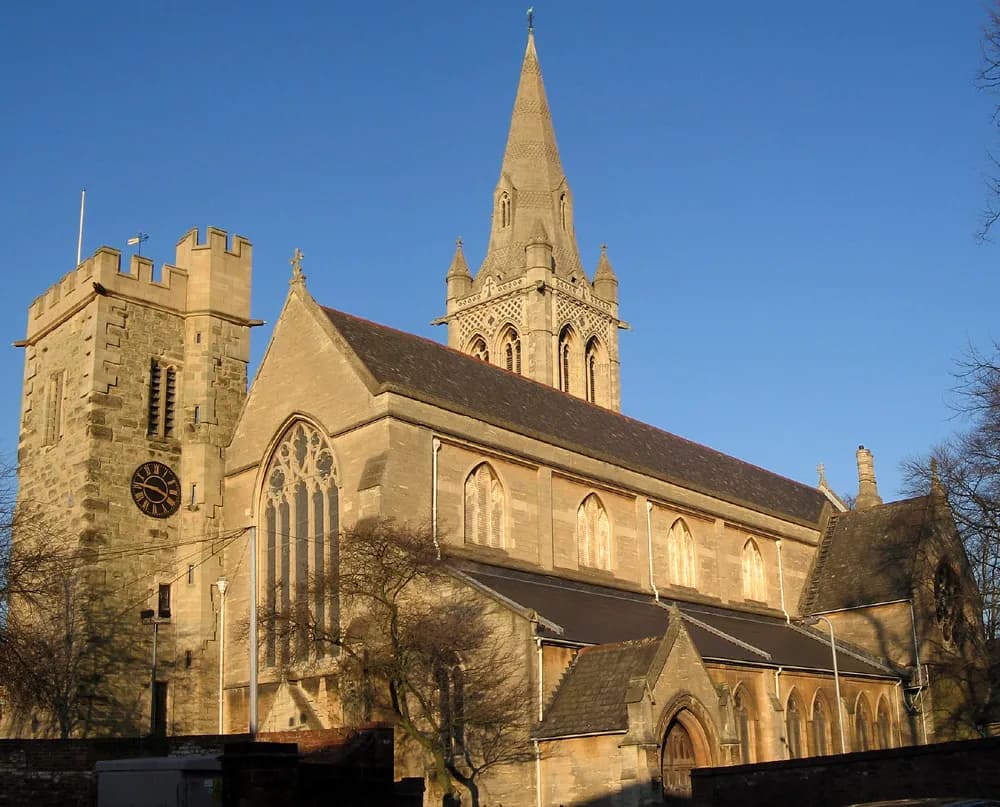
St Andrew's Church has stood at the centre of Rugby, Warwickshire for nearly nine centuries. First mentioned in 1140 as a chapel of ease to the mother church at nearby Clifton-upon-Dunsmore, it became a parish church in its own right in 1221 and has since borne witness to the town's transformation from a small medieval settlement to an industrial centre known worldwide for a sport that bears its name.
Origins and Early Centuries
The first church at this site was recorded in 1140, serving as a chapel of ease under the authority of the parish church at Clifton-upon-Dunsmore. Nothing of this original structure is thought to remain; the present building's oldest fabric dates from the 13th and 14th centuries.
The medieval church that stood here in the 1200s featured a nave arcade with octagonal piers and a north aisle that survive to this day. A 72-foot high west tower was added in the 14th century, possibly during the reign of Henry III. Local tradition suggests the tower was built with stones from a demolished castle, giving it a fortified appearance that reflects the tensions of the period.
Within the medieval structure, a 13th-century parish chest and a medieval font remain as tangible links to these early centuries. The church would have served a small agricultural community, long before Rugby became synonymous with the game that would make it famous.
Civil War and the 17th Century
The church stood through the turbulent years of the English Civil War. In 1642, King Charles I passed through Rugby with 120 Cavalier troops en route to Nottingham, whilst the townsfolk largely sympathised with the Parliamentarian cause. The Cavaliers disarmed the townspeople as they passed through. In April 1645, Oliver Cromwell and two regiments of Roundhead soldiers stayed at Rugby during the course of the war. The church itself would have served both factions, as parish churches did throughout that divided period.
The Victorian Transformation
By the 19th century, the medieval structure was no longer adequate for Rugby's growing population, driven in part by the expansion of Rugby School and the arrival of the railway in 1838. The town needed a larger church to serve what had become a significant industrial and educational centre.
The transformation came through William Butterfield, one of the most significant architects of the Gothic Revival. Butterfield had already worked at Rugby School between 1860 and 1870, designing new buildings and altering existing ones. His connection to the school brought him to the attention of the parish, and he was commissioned to rebuild St Andrew's.
The foundation stone was laid on 16 June 1877 by Archbishop Fisher, himself a former headmaster of Rugby School. The main rebuilding was completed in 1879, with the sanctuary finished by 1885. Butterfield's design retained only the medieval west tower and the north nave arcade, rebuilding everything else on a larger footprint to accommodate the expanded congregation. His characteristic style, using alternating bands of Bath stone and red Alton stone, gave the interior its distinctive polychromatic appearance.
In 1895, the east tower and spire were added to Butterfield's design, rising 182 feet (55 metres) above the town. The work was completed by Ewan Christian in 1895–1896, following Butterfield's original plans. The result was one of the most significant Victorian churches in the English Midlands.
Connection to Rugby School
The church's history has long been intertwined with Rugby School, founded in 1567 by Lawrence Sheriff. The school originally occupied premises north of St Andrew's Church, before moving to its present location south of the town centre by 1750. The presence of the school drove population growth in Rugby from the 18th century onwards, creating the need for the church's Victorian expansion.
William Butterfield's work at the school preceded his rebuilding of the church by several years, and his architectural legacy connects both institutions. The church continues to serve the school community, as it has for centuries.
The Church Today
St Andrew's is now Grade II* listed and recognised as a Major Parish Church, part of a select network of significant Church of England buildings. It stands in the Liberal Catholic tradition and serves as the parish church of Rugby St Andrew, within the Diocese of Coventry.
The church styles itself "Rugby's Town Church" and maintains a pattern of regular worship, including daily services and a Sunday Parish Eucharist at 10:30am. It remains open daily to visitors and pilgrims.
Beyond worship, the church functions as a community hub, hosting concerts, events, and operating a café. Its location at the heart of the town makes it a natural gathering point for civic as well as religious occasions. The medieval tower and Victorian spire continue to dominate the town's skyline, a visible reminder of Rugby's long history.
Architectural Heritage
The church's interior preserves significant Victorian craftsmanship, including stained glass by Clayton and Bell, mosaics by Antonio Salviati, and wrought iron screens by Alec Miller. The surviving medieval elements, including the 13th-century parish chest and font, provide continuity across nine centuries of worship.
The building's footprint covers 1,035 square metres, making it one of the larger parish churches in the region. Its dual towers, the medieval west and Victorian east, create a distinctive silhouette that identifies the town from a distance.